Hit enter to search or ESC to close
Selecting the right equipment for weaving hexagonal wire mesh often comes down to a balance between mesh precision and operational throughput. While many manufacturers rely on legacy systems, the shift toward PLC-controlled automation is redefining how these meshes are produced for everything from agricultural fencing to complex industrial filtration.
The technical challenge lies in maintaining a consistent twist and aperture size while minimizing wire waste and energy consumption. As raw material costs fluctuate, the efficiency of the weaving process becomes the primary lever for maintaining profitability in the wire mesh industry.
Understanding the mechanical nuances of a hexagonal wire mesh machine is essential for operators who need to scale their production without exponentially increasing labor costs.


The transition from manual and semi-automatic twisting to fully integrated systems has been driven by the need for tighter tolerances. Early machines struggled with consistency in "positive twist" configurations, often resulting in uneven mesh sizes that compromised the structural integrity of the final product.
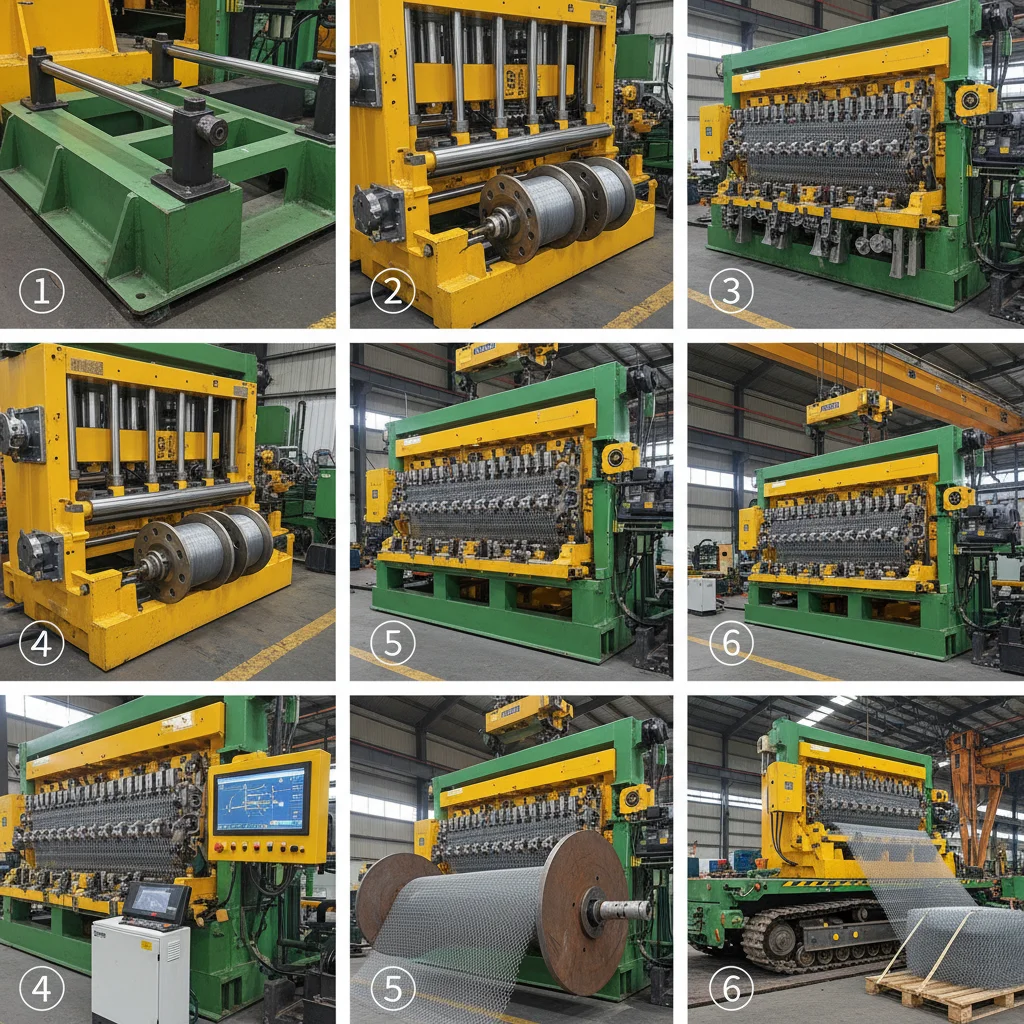
Current engineering focuses on the horizontal structure, which reduces vibration and allows the machine to run more smoothly at higher speeds. Hebei Mingyang Intelligent Equipment Co., Ltd. has integrated these advancements, moving from traditional mechanical linkages to a more streamlined, PLC-driven architecture.
The core of a high-performance hexagonal wire mesh machine is its ability to handle varying wire diameters while maintaining the hexagonal geometry. This requires precise synchronization between the wire feeding system and the twisting mechanism. The use of galvanized iron wire or plastic-coated wire introduces different friction coefficients, necessitating a design that can adapt to different material tensions.
Modern designs utilize PLC (Programmable Logic Controller) equipment to manage the timing of the weave. By digitizing the process, operators can adjust parameters for different mesh sizes—ranging from small 10mm apertures for specialized insulation to larger gaps for agricultural fencing—without needing to manually rebuild the mechanical timing gears.
Furthermore, the integration of spool winding and spring winding capabilities allows for a more continuous production flow. Reducing the number of manual interventions between the drawing process and the weaving process minimizes the risk of wire kinks and surface damage.
Labor costs often constitute a significant portion of the overhead in wire mesh production. Traditional machines required constant supervision and multiple operators to manage the feed and the take-up of the mesh.
The transition to PLC-controlled horizontal structures enables a reduction in staffing, allowing as few as two people to operate a complex weaving line without sacrificing quality control or safety.
This reduction is not just about head-count but about the redistribution of skill. Operators move from being "manual adjusters" to "system monitors," focusing on material quality and final product inspection rather than fighting the machine's mechanical inconsistencies.
Performance efficiency varies significantly based on the target mesh size. Smaller mesh sizes generally require higher precision in the twisting mechanism and may impact the overall weaving speed. For instance, producing a 10mm mesh requires a tighter synchronization compared to a 55mm mesh.
The following index illustrates the relative balance between production speed, energy consumption, and material precision across different typical mesh size categories.
Small hexagonal mesh is particularly valued for its flexibility and structural stability, making it ideal for pipeline insulation, specialized breeding enclosures, and decorative floral arrangements. The ability to weave both galvanized and plastic-coated wires allows these products to be deployed in corrosive environments or areas requiring specific aesthetic standards, such as wedding decorations.
In larger scales, hexagonal mesh serves as the foundation for gabion baskets and grassland fencing. The stability of the weave prevents the mesh from unraveling when cut, a critical requirement for construction and erosion control projects where the mesh must hold heavy stone loads.
The trajectory of wire mesh machinery is moving toward "intelligent" production. This involves the integration of real-time sensors that can detect wire breaks or tension variances instantly, automatically pausing the machine to prevent the production of defective rolls.
Furthermore, the exploration of new materials, such as high-strength PET (Polyester) for fishing nets and specialized aquaculture mesh, is pushing the boundaries of weaving speeds. The transition toward PET material requires different tensioning logic than traditional galvanized steel.
Sustainability is also becoming a key driver. Reducing the electricity consumption through high-efficiency motors and optimizing the footprint of the machine allows manufacturers to increase their production density per square meter of factory space.
Investing in a weaving system requires a detailed analysis of the intended product mix. A manufacturer focusing on pipeline insulation needs a machine capable of very small mesh sizes (10mm), whereas a fence producer prioritizes width and speed.
Key trade-offs often exist between the complexity of the PLC system and the ease of maintenance. While highly automated systems reduce labor, they require operators with basic digital literacy to manage the software interfaces.
The following table provides a comparative framework for evaluating different machinery configurations based on typical industrial requirements.
| Application Requirement | Critical Parameter | Recommended Design | Operational Priority |
|---|---|---|---|
| High-Precision Small Mesh | 10-20mm Aperture | Positive Twist PLC | Dimensional Stability |
| Heavy-Duty Fencing | Wire Diameter >1.2mm | Horizontal Structure | Tension Consistency |
| Corrosive Environments | Plastic Coated Wire | Adjustable Friction Feed | Surface Integrity |
| Mass Production | High Width/Speed | Integrated Winding | Throughput Rate |
| Budget-Constrained | Standard Mesh Sizes | Simplified Mechanical | Maintenance Ease |
| Specialized Materials | PET/Polyester | Custom Tension Control | Material Elasticity |
A horizontal structure significantly reduces the center of gravity and minimizes mechanical vibration during high-speed operation. This leads to a smoother run, reducing the wear and tear on internal components and ensuring that the wire twist remains consistent across the entire width of the mesh, which is critical for high-precision industrial applications.
Yes, modern hexagonal wire mesh machines are designed to be versatile. However, because PVC-coated wire has a different diameter and surface friction compared to galvanized iron, the machine's feeding and twisting settings must be adjusted. PLC-controlled systems make this transition much faster by allowing digital parameter updates rather than manual mechanical changes.
PLC (Programmable Logic Controller) integration simplifies the operational interface and automates the synchronization of the weaving process. This reduces the need for highly skilled manual adjusters and allows a smaller team—typically two people—to manage the entire production line, thereby significantly lowering long-term labor overhead.
Advanced new-design positive twisted machines can achieve a minimum mesh size of 10mm. Achieving this requires high-precision twisting mechanisms and very tight tolerances in the wire feeding system to prevent the mesh from collapsing or distorting during the weaving process.
The choice depends on the end-use application of the mesh. Positive twist is often preferred for stability in fencing and construction, whereas reverse twist might be required for specific industrial filters or specialized packaging. Buyers should evaluate the physical properties of the finished mesh—such as shrinkage and tensile strength—relative to their project needs.
Generally, yes. PET (Polyester) has different elasticity and thermal properties than steel. Weaving PET requires specific tension control and specialized winding systems to prevent the material from stretching or snapping. Investing in a machine specifically designed for PET ensures higher output speeds and a more stable mesh structure.
The evolution of the hexagonal wire mesh machine reflects a broader trend toward industrial intelligence and resource efficiency. By prioritizing PLC integration and horizontal stability, manufacturers can now produce highly consistent mesh products with a fraction of the labor previously required.
For businesses looking to scale, the focus should move beyond the initial purchase price toward the total cost of ownership, considering energy efficiency, labor reduction, and the ability to adapt to new materials like PET. Precision in the machinery today ensures a competitive edge in the diverse markets of tomorrow.