Hit enter to search or ESC to close
The global demand for versatile fencing and industrial filtering solutions has pushed the evolution of wire processing technology toward higher precision and automation. At the center of this shift is the hexagonal wire mesh machine, a specialized piece of equipment designed to weave wire into the characteristic honeycomb structure known for its exceptional structural stability and flexibility.
Modern industrial applications, ranging from poultry breeding and pipeline insulation to high-end floral decoration, require mesh with strict uniformity and tension control. The transition from manual or semi-automatic systems to PLC-controlled automation has become a critical factor for manufacturers aiming to reduce labor overhead while increasing output consistency in harsh production environments.
This technical analysis explores the engineering mechanisms behind high-efficiency weaving, the impact of PLC integration on operational costs, and the key parameters buyers must evaluate to ensure the equipment matches their specific wire gauge and mesh size requirements.


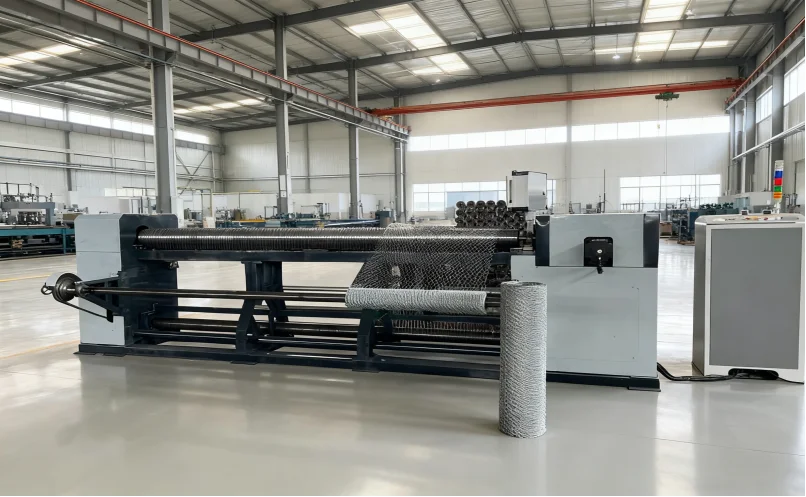
The production of hexagonal mesh relies on a precise twisting and twisting-back sequence. Unlike standard square mesh, the hexagonal structure is formed by twisting the wire in a specific direction and then allowing the tension to stabilize the geometry. A horizontal machine structure is typically employed to ensure smoother running and reduced vibration during high-speed operation.
The efficiency of the weave is determined by the synchronization between the feeding system and the twisting head. In advanced systems, the use of positive twisting mechanisms allows for the creation of smaller mesh sizes, with some precision equipment capable of reaching a minimum mesh size of 10mm.
When selecting a hexagonal wire mesh machine, the relationship between wire diameter and mesh width is the primary engineering constraint. For instance, a machine configured for a 3/8 inch mesh typically handles wire diameters ranging from 0.38mm to 0.5mm. Deviating from these calibrated ranges can lead to uneven tension and structural deformation of the honeycomb cells.
Motor power (KW) must be scaled to the wire thickness and the number of twists required. Heavier gauges require higher torque to maintain the twisting speed, and the stability of the power supply directly affects the uniformity of the mesh. For example, 5/8 inch mesh configurations often require higher motor capacities (up to 22KW) compared to 3/8 inch models (typically 3-5KW).
Material compatibility is another vital factor. Industrial-grade machines are designed to handle both galvanized iron wire and plastic-coated wire. Coated wires introduce different friction coefficients and diameters, necessitating precise adjustment of the feeding rollers to prevent stripping the coating during the weaving process.
The integration of Programmable Logic Controllers (PLC) has transformed the hexagonal wire mesh machine from a mechanical tool into an intelligent production system. By digitizing the timing of the twists and the feed rate, manufacturers can achieve a level of repeatability that was previously impossible with manual gearing.
Furthermore, PLC systems facilitate faster changeovers between different mesh sizes. Instead of manually replacing gears or adjusting mechanical cams, operators can input parameters into the interface, allowing the machine to adapt to customized mesh specifications with minimal downtime.
Evaluating the efficiency of weaving equipment requires looking beyond raw speed. The true metric of success is the ratio of usable mesh to raw material waste, coupled with the energy consumption per linear meter of produced mesh.
Modern designs focus on reducing the overall footprint of the machine, which not only saves factory space but also reduces electricity consumption by optimizing the motor's load distribution across the horizontal structure.
The resulting mesh from a hexagonal wire mesh machine is utilized in diverse high-stress environments. In agriculture, it is indispensable for poultry breeding and grassland fencing where the mesh must resist deformation under pressure. In construction and civil engineering, larger hexagonal weaves are utilized for gabion baskets and pipeline insulation, protecting infrastructure from erosion and thermal loss.
Beyond heavy industry, small-mesh variations are increasingly used in the creative sector. The precision of 10mm mesh is particularly suited for floral decoration and wedding arrangements, where the wire must provide rigid support without being visually intrusive. This versatility makes the ability to customize mesh size a critical competitive advantage for equipment owners.
The industry is moving toward fully integrated production lines where the wire drawing machine and the weaving machine are synchronized via a centralized control system. This reduces the need for intermediate spooling and minimizes the handling of raw materials, further lowering the cost per unit.
Another emerging trend is the development of PET (Polyester) hexagonal mesh equipment. As environmental regulations push for sustainable materials, the transition from galvanized steel to high-strength polymers requires new weaving dynamics. Equipment that can handle the elasticity of PET while maintaining a constant hexagonal geometry represents the next frontier of R&D.
Finally, we expect to see the integration of IoT sensors within the weaving heads to monitor real-time wear and tear. Predictive maintenance will allow manufacturers to replace critical components before a break occurs, ensuring continuous output in 24/7 production cycles.
Choosing the right configuration requires a balance between the desired mesh width and the required wire diameter. The following matrix provides an engineering baseline for matching machine capacity to production goals.
It is important to note that customized types are often necessary for niche applications, such as extremely fine meshes for specialized insulation.
The power requirements scale linearly with the diameter of the wire being processed, as indicated in the motor specifications below.
| Configuration Type | Mesh Size / Width | Wire Diameter Range | Motor Requirement |
|---|---|---|---|
| Precision Setup | 10mm / 1200mm | 0.38mm - 0.5mm | 3-5 KW |
| Standard Duty | 3/8" / 1200mm | 0.38mm - 0.5mm | 15 KW |
| Medium Gauge | 1/2" / 1200mm | 0.38mm - 0.8mm | 18 KW |
| Heavy Duty | 5/8" / 1200mm | 0.38mm - 0.9mm | 22 KW |
| Industrial High-Cap | 3/4" / 1200mm | 0.38mm - 1.0mm | 27 KW |
| Max Gauge Setup | 1.5" / 1200mm | 0.4mm - 1.5mm | 55 KW |
Modern positive twisted hexagonal wire mesh machines can achieve a minimum mesh size of 10mm. This precision is made possible by high-resolution PLC control and a horizontal structure that minimizes mechanical vibration during the twisting phase, making it ideal for specialized applications like floral decoration.
Yes, the equipment is designed to weave both galvanized iron wire and coated wire. However, when using coated wire, the diameter must be carefully measured to include the coating thickness, and feeding rollers should be checked to ensure they do not damage the outer layer during the weaving process.
The PLC system automates the synchronization of the weaving cycle and wire feeding. This simplifies the operation to a level where only two people are needed to manage the entire process, significantly reducing long-term labor expenses compared to manual or semi-automatic machines.
A horizontal structure provides a more stable center of gravity and better distribution of mechanical stress. This results in the machine running more smoothly at higher speeds, reducing wear on the twisting components and ensuring a more consistent mesh geometry.
Motor power is determined by the wire diameter and the mesh size. For light wires (0.38-0.5mm) and small mesh sizes, a lower KW motor is sufficient. However, as the wire diameter increases toward 1.5mm, high-torque motors (up to 55KW) are required to maintain weaving speed and tension.
Yes, most industrial manufacturers offer customized types to match specific application needs. This includes adjusting the machine frame for different mesh widths or modifying the twisting head to create unique cell geometries required for specialized industrial filters or architectural screens.
The evolution of the hexagonal wire mesh machine underscores a broader industry shift toward precision automation. By balancing mechanical stability via horizontal structures with the intelligence of PLC systems, manufacturers can now produce highly consistent hexagonal weaves that meet the stringent requirements of both heavy civil engineering and delicate artistic applications.
For buyers, the key to ROI lies in matching the machine's motor capacity and twisting mechanism to the specific wire gauge and intended mesh size. Investing in an automated system not only ensures product quality but fundamentally alters the cost structure of the production facility by reducing labor dependency.